Showing posts with label past events. Show all posts
Showing posts with label past events. Show all posts
Monday, October 19, 2009
Update on last week's William Morris Endeavor Agency event
I've been running around all week with no time to blog (mostly working on the article, and blog posts will come soon), but I had to stop and say what an amazing time we had on Thursday with Eric Lupfer as our guest. The praise has continued to pour in for his candid talk and his accessibility afterward, waiting patiently to speak with a line of faculty and guests. Thank you to everyone who came and made it such a full house, and thank you to Eric who was such a great sport.


Wednesday, November 19, 2008
Book Fair at the National Press Club -- Aftermath
 We survived! There were record crowds last night, and it was wonderful to meet Roger Mudd, James Reston, Jr., Justice Scalia, and to re-meet Helen Thomas and Chip Bok, Alan Geoffrion, Russell Baker, Jim Wooten, and other stars. This is a photo of your book blogger (exhausted from chairing Book Fair this year, but trying not to show it) with (l-r) Jacques Berlinerblau, author of Thumpin' It, Alison Crowley, a Georgetown student who works in this office, and James J. O'Donnell, author of The Ruin of the Roman Empire.
Sunday, September 21, 2008
Jim O'Donnell at Politics and Prose with "The Ruin of the Roman Empire"
 A standing-room-only crowd filled Politics and Prose on Saturday, September 20 to hear Georgetown's Provost James J. O'Donnell read from and discuss his new book, The Ruin of the Roman Empire (HarperCollins/ Ecco). Among the animals joining him at the podium was a donkey, and it stood as more than a mascot -- it was a harbinger of a book to come.
You can also listen to his interview with Lewis Lapham on The World in Time, his weekly program on Bloomberg Radio.
Thursday, September 04, 2008
Cary Goldstein's Talk -- the Reviews are in!
A record number of Georgetown faculty turned out to dine and chat with acquisitions editor and chief publicist (yes, both roles can reside in the same professional) Cary Goldstein from TWELVE. What struck many participants about Cary's talk was how affable he is, and how easy it was to communicate with him about books. The myth is that New York editors expect formal interaction and prefer stiff introductory letters that will make or break your case by paragraph two. The reality is that they're just people -- smart, well-read people with a lot of experience in publishing -- but human nonetheless, and a good deal more approachable than folks in many other professions. I've been getting e-mails all afternoon from faculty who were inspired by the event and who are interested in thinking about their work for a larger audience.
Academic vs. trade is an interesting choice. Most recently hired scholars choose academic for professional reasons (tenure), but that's not a sufficient reason to choose one press over another. Scholarly work should be crafted to speak to colleagues and to work beautifully within the university press publishing realm. Trade work -- even if based on the same research -- must be written differently, and operate in a way that meets the demands of a fickle and volatile book market. Cary emphasized the importance of the work itself -- not the pitch for the work, or the stature of the author, or the needs of the market, although all those elements are important -- but the art of the words on the page and the way they do their job.
As conceived by founding editor Jonathan Karp (the editor behind Seabiscuit and The Orchid Thief among many others) TWELVE only publishes twelve titles a year, so it is committed to a challenging combination of selectivity and success in a way that other presses are not. It can't hedge its bets by publishing 50 solid choices, and hoping that ten break out. Every book should pull its weight both in the intellectual arena of The New York Review of Books, the few other book reviews that are left (Cary cited NYTimes, Washington Post, and San Francisco Chronicle as the last three papers with separate book review sections, and I've heard the latter is in flux), in the intellectual blogosphere, and in the bookstore. It's an enormous challenge, and one that it was exciting to hear about from such an exceptional publishing professional and one of its two intellectual guiding forces.
Thursday, August 28, 2008
James J. O'Donnell and "The Ruin of the Roman Empire" at Politics and Prose
 Jim O'Donnell will be at Politics and Prose bookstore on Saturday, September 20 with his new book, The Ruin of the Roman Empire. The bestselling author of Augustine: A New Biography will discuss his fresh take on a not-so-well-known story, and sign books. 1 p.m. A map to Politics and Prose is here.
Wednesday, August 20, 2008
Editor and Publicist Cary Goldstein of TWELVE Comes to Booklab
 On September 4 at 12:30, Director of Publicity and Acquiring Editor Cary Goldstein at Hachette's estimable imprint TWELVE will be our guest at a faculty roundtable to discuss how academic authors can become quoted experts in today's voracious news climate. How do serious works (history, investigative journalism, politics, etc.) rise to the top in the age of the internet and 24-hour news? From framing your nonfiction book proposal to anticipate this question, to the differences between the academic and commercial book markets when it comes to writing your work, Goldstein will analyze nonfiction from both of his unique perspectives: as an acquisitions editor, and as a senior-level publicity strategist. He'll also discuss TWELVE and what distinguishes its editorial and promotional approach from other houses. Faculty are welcome and lunch will be served. RSVPs are an absolute must, so please drop a note to booklab for confirmation and the exact location.
A recipient of the Thomas Wolfe Memorial Poetry Prize at New York University, Goldstein's poetry has been published in The Literary Review. His reviews and articles have appeared in Publishers Weekly, The Village Voice, and Time Out New York. Goldstein has handled publicity for all sixteen titles published by TWELVE, eight of which have been New York Times bestsellers, including Boomsday by Christopher Buckley, God is Not Great by Christopher Hitchens, Microtrends by Mark Penn, The Commission by Philip Shenon, and The Fortune Cookie Chronicles by Jennifer 8. Lee.
Monday, April 14, 2008
Mildred Marmur visits Booklab!
Booklab has a new mentor -- literary agent Milly Marmur, who has generously offered to hold a Q&A with faculty on Tuesday, April 15 from 3-4 p.m. Milly was president and publisher of Charles Scribner's Sons before founding the Mildred Marmur Associates Ltd literary agency in 1987. Prior to that she was Vice President and Director of Subsidiary Rights at Random House Adult Trade, and she previously held the same position at Simon & Schuster. Whew!
In 1974 at Simon & Schuster she auctioned paperback rights for ALL THE PRESIDENT'S MEN for a then-record $1,000,000. At Random House the following year she did the same for E. L. Doctorow's RAGTIME, earning a record $1,850,000 for a literary novel. During her leadership at Scribners, she published Ernest Hemingway's last novel THE GARDEN OF EDEN, 25 years after his death, and Barry Lopez's ARCTIC DREAMS, both of which became best-sellers. As an agent, she has represented food scientist Harold McGee (ON FOOD AND COOKING), David Bornstein (HOW TO CHANGE THE WORLD), Ethan Bronner, Middle East correspondent for The New York Times, Lawrence K. Altman, M.D., medical writer for the Times, Georgetown adjunct law professor William Taylor (THE PASSION OF MY TIMES), and stage and screen actor Theodore Bikel (THEO: An Autobiography). Mr. Bikel, an Academy Award nominee, is of course in residence here at Georgetown this week with Serendipity4, including Grammy-nominated conductor Tamara Brooks, accordionist Merima Kljuco and Yiddish folk singer Shura Lipovsky.
Besides her work as a publisher and then as a literary agent, Marmur has a master's degree in French literature, and has published a number of translations from the French. Her translation of MADAME BOVARY, edited by E. L. Doctorow, is available as a Signet Classics paperback and was issued in audio with Claire Bloom reading. Her translation of Moliere's THE IMAGINARY INVALID has been performed in many states, and most recently at Columbia University.
Milly will field questions from faculty members and offer a glimpse into publishing as she knows it so very well.
Tuesday, February 26, 2008
Bestselling author Thomas Moore comes to Booklab
 Last fall Sebastian Junger, author of The Perfect Storm and A Death in Belmont came to Booklab for a faculty lunch and roundtable on nonfiction book publishing. Now we have another bestselling author on the way! On Tuesday, March 11, Thomas Moore -- author of The Care of the Soul among many others -- will be here to discuss his new book A Life at Work. This lunch and roundtable for Georgetown faculty will focus on publishing works of faith, and how authors who write about spiritual matters might think about their work for mainstream audiences. Moore will join us at the John Main Center for Meditation at 12:30, and then his talk will begin at 1:15 p.m. in the Provost's conference room on the 6th floor of ICC. RSVPs are an absolute must because of space limitations. This promises to be just as informative and one-on-one as the Junger event, so please reserve early.
Tuesday, February 05, 2008
More James O'Donnell on radio . . .
This is a fun one: the radio show Philoso?y Talk, "the program that questions everything... except your intelligence." From Stanford University, it is hosted by Ken Taylor, the chair of the philosophy department, and John Perry, a philosophy professor.
Wednesday, January 30, 2008
Hear JO'D on the BBC
 Georgetown's Provost, James O'Donnell, recorded a piece about St. Augustine for BBC Radio 3’s new 12-part series The Essay: Greek and Latin Voices. (I was the producer on the Georgetown side, and then handed it off to a BBC producer in the U.K.) Since this office specializes in recorded pieces for radio, his BBC invitation provided an excellent opportunity to showcase our new capabilities, and to think about the spoken word and books.
Books and radio are a natural pairing. For example, we know from audience analysis that public radio listeners and book buyers are almost a 1-1 match. If an author finds a public or news/ talk radio audience, book sales very often follow.
If you're an author, how can you get your pieces on radio? Drop a note to booklab@georgetown.edu and ask about a radio consultation. You may not start out on the Beeb, but there are public radio stations all over the country where your voice very well might be welcome.
Sunday, November 25, 2007
Theatre review: Mojo Mickybo
 It was always in the plan to include theatre reviews in this blog, but the year got away from me. Mostly I want to focus on plays based on books (to stay with the publishing theme), but I can't resist starting off with an Owen McCafferty gem that was written as a play: Mojo Mickybo. You can watch an interesting preview here, and this is a link to the theatre and a slew of reviews.
It is an absolute must that you have seen Butch Cassidy and the Sundance Kid before attending this play... some of the wittiest parts including the music will make absolutely no sense unless you do! I don't know why they don't emphasize this more in the play's materials, but since the story is about two boys who love the movie and transpose its hipster outlaw themes to their war-torn world in 1970 Belfast, it surely makes sense to have experienced the movie yourself. Perhaps the playwright thought everyone has seen it, and I'll grant that it was a cultural phenomenon when it came out, but many people born after 1980 probably missed it, even on video or DVD.
Overall I felt that Mojo Mickybo is less a play than an extended riff: it's a way of putting the audience in the minds of the children of Belfast. But could it or should it have been more? The actors, Christopher Dinolfo and Mike Innocenti, are spot-on, even with simulated accents (an affectation I normally loathe, but they handled it well), and director Eric Lucas demonstrates cleverness beyond mere technical skill... he drew children out of these grown men on the stage, and we seldom remembered that we were watching actors at least 20 years older than the boys they portrayed. But why did the playwright stop there? At a mere 85 minutes we have some laughs and a poignant portrait of McCafferty's Belfast to stand alongside Brian Friel's fictional Ballybeg, Roddy Doyle's Dublin, or (perhaps) Frank McCourt's Limerick (albeit with many of the same, tired stereotypes of Ma at the ironing board and Da at the pub). Now I would love to see a richer play with two full acts and substance beyond mere interest.
Should you see the play? Absolutely, if only for the great buzz of watching two talented actors in the hands of a gifted director fully embody these boys. Also, the charming and comfortable Church Street Theatre in Dupont Circle charges an entirely humane $25 rather than the nosebleed ripoff prices of some other DC theatres I could name, and that sanity in pricing should be rewarded with full houses. But what will you get out of it besides a sense that the playwright is really onto something, and ought to expand that idea? Please see it and comment here with your thoughts.
Monday, November 12, 2007
Orhan Pamuk, the follow-up
Okay, so I was trying to think of what to say to a Nobel Laureate who just received an honorary doctorate, and not sound like a dork or like some bah-hah academic or something. I closed my eyes for a moment and remembered what it looked like to see him walk down the aisle in Gaston Hall with all those be-robed colleagues, ascend the stage, and receive the honorary doctoral hood. It kinda looked like getting married! I asked him about that, and he laughed and said yes, that's exactly what it felt like. He said the moment is surreal, and over very quickly, before you realize what is happening.
He was so laid-back and he seemed to have fun, like he does this all the time (which perhaps he does). His beautiful daughter Rüya was with him. I have met enough famous authors by now to be tired of the thrill. Most are okay, some are awful, but overall writers are better on the page than in person. Orhan Pamuk was an exception to that. He's a bit more interesting in person.
He snapped a photo of the three of us with his digital camera, and I regretted not having one myself, but I didn't know if it would be appropriate. D'oh. I hope he reads this and decides to send the image. Booklab at georgetown dot edu.
Monday, October 22, 2007
See Orhan Pamuk Live at Georgetown University
 The 2006 Nobel laureate will be at Georgetown University's Gaston Hall Monday, October 29, at 5 p.m. to receive an honorary degree. The event is free. They aren't planning to sell books at the event, so if you want a book signed, bring it along! Also, you need a government-issued ID to get in, and they won't allow backpacks, bags or purses (ah, security...). These things really fill up, and there will be a line, so I strongly suggest getting there by at least 4:15 for a good seat. Doors open at 4 p.m., which is when I'll be there.
(There are many photos of him on the web, but this one is my favorite. Does anyone have a photo credit line for it?)
Monday, October 08, 2007
"Scent of Desire" at the National Press Club
 A new book about the psychology of the olfactory by Dr. Rachel Herz of Brown University is to be the subject of a five-course wine dinner at the National Press Club on Thursday night, October 11. This promises to be one of the most intriguing and enticing dinners the club has hosted yet. For those of you who don't know about them, the NPC's wine dinners are usually chances to meet, mingle, and dine with famous chefs who have new books. I met Anthony Bourdain there at a wonderful dinner that featured robust and meaty fare; Baltimore chef and PBS host John Shields with a seafood-based meal focusing on Chesapeake Bay specialties; and the club has also hosted Jacques Pepin, Bobby Flay, Giada De Laurentiis, and many more. But a university professor who studies scent as an academic discipline? This is surely a first!
Here's the blurb: "Executive Chef Jim Swenson has created a multi-sensory journey through a rare six-course scent dinner. Each spectacular course will be paired with a different scent tailored to its unique properties and thus showing the direct link between scent and food. Join us for this interactive, luxurious, and unique dinner that will show you how food plays a great role in the development of fragrances."
To reserve a place (Members $67 Non Member $89 -- price includes tax and gratuity), call 202-662-7638 or e-mail fourthestate@press.org. And if you want to meet the Book Blogger, I'll be there!
Friday, October 05, 2007
While we're obsessing about money, what's up with David Sedaris?
 I don't necessarily have a problem with this, but I'm curious how an author on book tour manages to command $35-$40 a head just to read, answer questions, and sign books. Apparently David Sedaris will be at Lisner Auditorium tomorrow night doing and charging just that. Meanwhile, uptown, you can see Chris Matthews at Politics & Prose for free, and the National Press Club book events -- where I've met Michael Crichton, John Irving, and Sebastian Junger, among others --are always free. Now the head-scratcher for me is whether I think these events should all be free, or if it is ever appropriate to charge moola.
One of the great things about living in Washington, DC is that every famous author -- including all the good ones you'd get in New York -- comes here. It never fails. If an author is smokin', Washington is on the list. We may be late getting movies, and we may usually have to settle for the touring cast of interesting plays (although I'd rather go to NYC for plays anyway), but dagnabbit, we get authors while they're hot.
So hmmmmm. Is it worth that much just to see another barbaric yawper? And how many people will show up?
Wednesday, May 23, 2007
Barbara Mujica at the National Press Club
 It was such a pleasure to hear Barbara Mujica (center) read from her new novel Sister Teresa -- about 16th century mystic Teresa of Ávila -- at the National Press Club on Monday night! Dozens of journalists packed into the Eric Friedheim National Journalism Library for the reading and a lively Q&A. At the left is host Katie King, a journalist with a long career in Spain and elsewhere in Latin America. Photograph by Darlene Shields.
Wednesday, March 07, 2007
The director of the University of Arizona Press at Georgetown
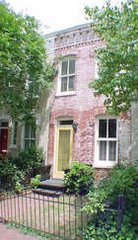
 As part of this office's ongoing effort to bring authors and university press publishers together, we are pleased to host Dr. Christine Szuter, director of the University of Arizona Press, for a question and answer session about book publishing on March 14 at 10:30 a.m. The location will be the Book Lab townhouse (right). Dr. Szuter will answer your questions about university press publishing as it pertains to her experience at Arizona. Every press is different in vital ways, so this is your chance to get to know what makes this publisher unique.
Possible topics include: (1) What is Arizona's editorial vision and scope, and how does it stand out from its peers? (2) How much publicity can and should the press handle, and what is the author responsible for? How can an author work with a university press publisher and also with book promotion resources here at Georgetown to increase a book's sales? (3) How does the peer review process work at Arizona? Is it a perfect system (short answer... it never is)? (4) What happens if Arizona rejects a book? Can and should the author ever try the press again? (5) What is the policy on subventions? How does Dr. Szuter feel about them, when and why does the press ask for them, and what do they mean for authors? (6) Rights! In this office I'm always suggesting that authors keep their copyright. But Dr. Szuter points out that with rights come responsibilities. Learn more about what owning your copyright means, and how you can and should exploit your reserved rights.
What: Q&A with Dr. Christine Szuter, Director of the University of Arizona Press
When: Wednesday, March 14, 10:30 a.m.
Where: Book Lab townhouse (see address at right)
All are welcome, but because of space considerations,
RSVPs are a must!
Tuesday, December 05, 2006
February Readings From the Villa Le Balze

With the help of John Glavin and Michael Collins I'm arranging an evening of faculty readings from creative work produced at or in relation to the Villa Le Balze in Florence. We're talking wine, Italian food, lush Italian music, and professors reading from their work while (we hope) it snows outside. What could be more welcome at the end of a cold slog through January? Tentative time is in the early evening. If you would like to participate or attend, RSVP to Carole now!
Friday, November 03, 2006
The Authors Guild at Georgetown - November 8
What kinds of questions will you want to ask when the Authors Guild is here November 8? To get the most out of this busy, informative session, do consider submitting your contracts ahead of time for review. Here are just some of the pressing questions this office has dealt with since it opened in January:
SAMPLE SCENARIOS
1. The publisher said it "doesn't negotiate," so you signed a boilerplate contract seven years ago. Now your editor says you have to produce an updated version of your book, even though you've long since moved on to other projects, you don't have the time, and you don't need it for tenure. The editor threatens to produce the volume with or without your cooperation, and to put your name on it anyway because she claims the publisher has that right. Can she do this? Do you have options?
2. You signed a contract allowing your journal publisher to distribute your article in all forms throughout the world forever. The publisher also kept the right to revise your article "as necessary." Consequently, the article was edited by someone whose political opinions are the opposite of yours. Not only were your boldest assertions watered down to the point where you sound weak and ineffective, but the publisher plans to distribute this piece worldwide, including electronic archives. Do you have any recourse?
3. Although it now wants to be seen as a literary force in the world of the big-box bookstores, a prestigious university press publisher also claims it never pays advances, so you accept a contract with no money upfront. Then you find out one of your junior colleagues did get an advance. What next?
4. You have a choice between two important university presses whose reputations are functionally equivalent. They each came to you and offered you a pre-contract for your high profile project. What does this mean? Is either publisher obligated to publish your book? Can you go ahead and continue talking to both of them in good faith while you finish your book, or do you have to make a decision about which one to publish with now, before your book is finished?
5. Speaking of pre-contracts, what if you're up for tenure in the future and a university press offers you a pre-contract? Should you take it? What does that nagging term "pre" actually mean? Can you count on them to publish your book?
6. Prestigious university press A offers you a contract and asks you for a $1,200 subvention. Less prestigious but still excellent university press B offers you a contract and does not ask for a subvention. You have no funding through your department at the moment because you used it all for another worthy academic project. Which publisher do you choose and why?
These are just some of the many real-world situations that professors find themselves in with university presses. The good news is that you can always negotiate a university press contract. There is no such thing as a business entity anywhere that "does not negotiate," no matter what its representatives say. The better news is that most university press editors and publishers are in it for the love of the game anyway (they could be making more money doing something else, even in publishing!), so you'd be surprised how many times they are tacitly on your side even when they seem to be pushing the old party line. Learn more about your rights, your responsibilities, smart strategies and more on November 8.
Friday, October 13, 2006
The best city in the world for poetry?
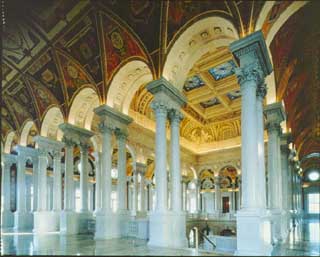 Some would say London, Paris or New York are better, but I choose Washington because of the Library of Congress and its amazing poetry series. Thanks to the office of the Poet Laureate (more precisely known as the Consultant in Poetry), we attract all kinds of cool poets, and it's usually completely free.
Two weeks ago U.S. Poet Laureate Donald Hall read to a packed house. Last night Pulitzer Prize-winning journalist and poet David Tucker, and the famous, venerable grizzled lion Galway Kinnell took the stage to a smaller but in many ways more devoted group (the Hall contingent had a number of college classes in attendance, many of whom surely showed up to get extra credit). Now it seems time to start taking small groups from this townhouse. The next event is Thursday, October 26.
Want to participate? After you RSVP, you should stop by this literary townhouse (address at the right) around 5 p.m. We'll walk down to Wisconsin Avenue, catch a 30 bus or the Circulator to Foggy Bottom, and then take Metro to Capitol South. Here's the event:
Jack Gilbert and Miranda Field
Jack Gilbert and Miranda Field
 Gilbert’s book Refusing Heaven (Knopf, 2005) won the National Book Critics Circle Award for poetry last year, and his chapbook, Tough Heaven: Poems of Pittsburgh, was published in limited edition this year by Pond Road Press. Soon after Gilbert’s first book, Views of Jeopardy (Yale University Press, 1962) was published, he received a Guggenheim fellowship and moved overseas to live in England, Denmark and Greece. He toured 15 other countries as a lecturer on American literature for the U.S. State Department. His second book, Monolithos, was a finalist for the Pulitzer Prize of 1983. The title is Greek for “single stone,” a reference to the terrain on the island of Santorini, where he had lived. He is also the author of The Great Fires: Poems 1982-1992.
Miranda Field was born and reared in London. Her poems have won the “Discovery”/The 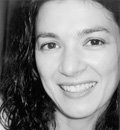 Nation Award and a Pushcart Prize. Her debut book Swallow won a 2001 Bakeless Prize in poetry. According to the book’s publisher, Houghton Mifflin, “Swallow swoops and darts, tangling the lines we draw between the wild and the cultivated.” Field was a teaching fellow at the 2002 Bread Loaf Writers’ Conference, and lives in New York City with her husband, poet Tom Thompson, and children.
 Nation Award and a Pushcart Prize. Her debut book Swallow won a 2001 Bakeless Prize in poetry. According to the book’s publisher, Houghton Mifflin, “Swallow swoops and darts, tangling the lines we draw between the wild and the cultivated.” Field was a teaching fellow at the 2002 Bread Loaf Writers’ Conference, and lives in New York City with her husband, poet Tom Thompson, and children.
Subscribe to:
Posts (Atom)